> For the complete documentation index, see [llms.txt](https://docs.wonderchat.io/llms.txt). Markdown versions of documentation pages are available by appending `.md` to page URLs; this page is available as [Markdown](https://docs.wonderchat.io/setup-guides/setting-up-your-chatbot/setting-up-multi-lingual-chatbots.md).
# Multi-lingual Chatbots
A quick guide on setting up multilingual chatbots if you have multilingual websit.
Wonderchat supports multilingual websites, allowing you to deploy chatbots that work seamlessly across multiple languages.
{% hint style="warning" %}
**Important:** Chatbots will always reply in the language that the user is speaking in. The language settings discussed in this guide are only for translating fixed messages such as greeting messages, fallback messages, and taglines.
{% endhint %}
## Methods to Set Up Multilingual Chatbots
### Method 1: Multiple Chatbots (One per Language)
The most straightforward approach is to create separate chatbots for each language.
**Benefits:**
* Each language's knowledge base is siloed from others
* Easier to manage if you have dedicated teams for each language
* Complete control over language-specific content
* Embed each chatbot on each language of your website
**Drawback:**
* Requires managing multiple chatbots
### Method 2: Multilingual Feature
{% hint style="warning" %}
**Only available on the Scale plan**
{% endhint %}
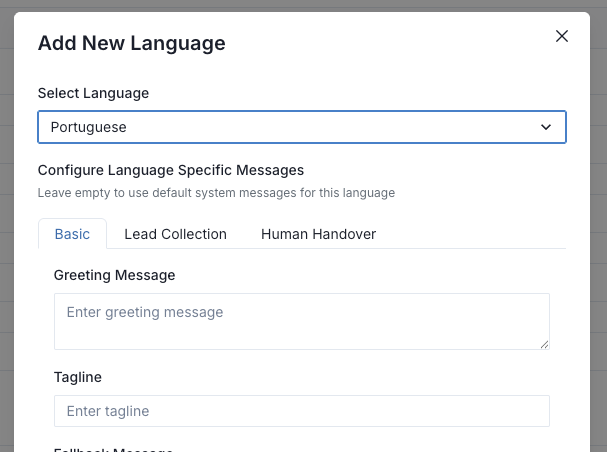
Our built-in multilingual feature allows you to add multiple languages to a single chatbot.
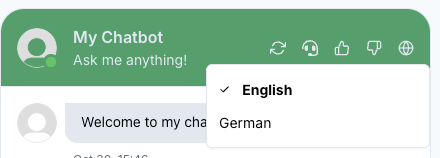
Once you’ve added multiple languages, a globe icon will appear in the header bar. Your users can click it to select their preferred language.
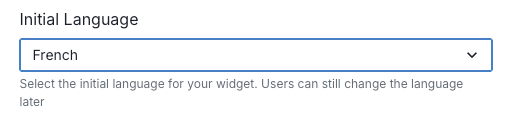
You can also set a **default (initial) language** in your embed script. This updates a script parameter that defines which language the chatbot loads in by default. For example, you can dynamically set the initial language based on the user’s domain or URL path — ideal for sites with separate language-specific pages or subdomains.
**Features:**
* Configure custom translations for:
* Chatbot tagline
* Greeting message
* Fallback message
* Other fixed UI elements
* Centralized management
### Method 3: Custom Script Override
You can also customize the greeting parameter directly in the embed script for different language pages, providing another way to manage your greeting messages for different languages
This method is detailed below and allows you to override fixed messages on a per-page basis.
***
### **Customizing Greeting Messages via Script Override**
To configure one chatbot to use a different greeting message based on the page language:
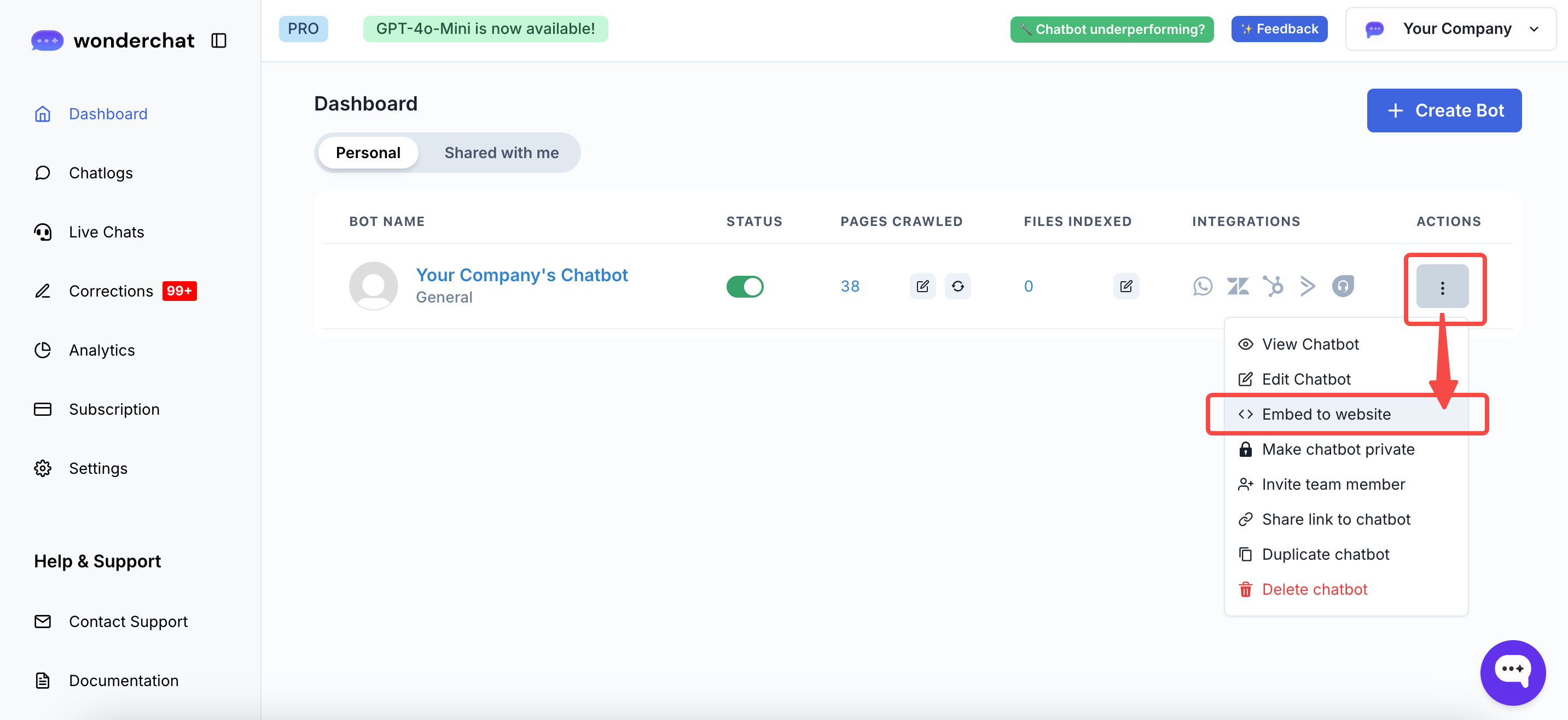
1. Click on **"Embed to Website"**.
Click on 'embed to website' to modify script settings
3. In the embed code, add a `data-greeting` parameter to override the default greeting:
```html
```
4. Use this customized embed code on your language-specific pages.
For example, here is how you can use a French greeting on pages that mainly use the French language.
```jsx
```
The bot will greet with "Hello there!", but if using the script:
```html
```
The bot will greet with "Bonjour", which you can switch this to whichever language in the different language domains of your website.
As long as the greeting message is displayed in the same language of the webpage, your users would be able to interact with the bot in their native language.
***
### **Step 3: Embedding onto your multi-language website**
You can copy and paste the same widget code, and make edits to the script parameter (data-greeting="Hello there!") to reflect the greeting in the language of your choice.
***
## Choosing the Right Method
* **Choose Method 1** if you have dedicated teams for each language and want complete separation of knowledge bases
* **Choose Method 2** if you're on the Scale plan and want centralized management with proper translation support
* **Choose Method 3** if you want a quick solution using script customization for basic greeting messages
***
If you have any more questions, feel free to reach out to us at ****
***